How IoT Application Development Services Connect Devices and Business Data
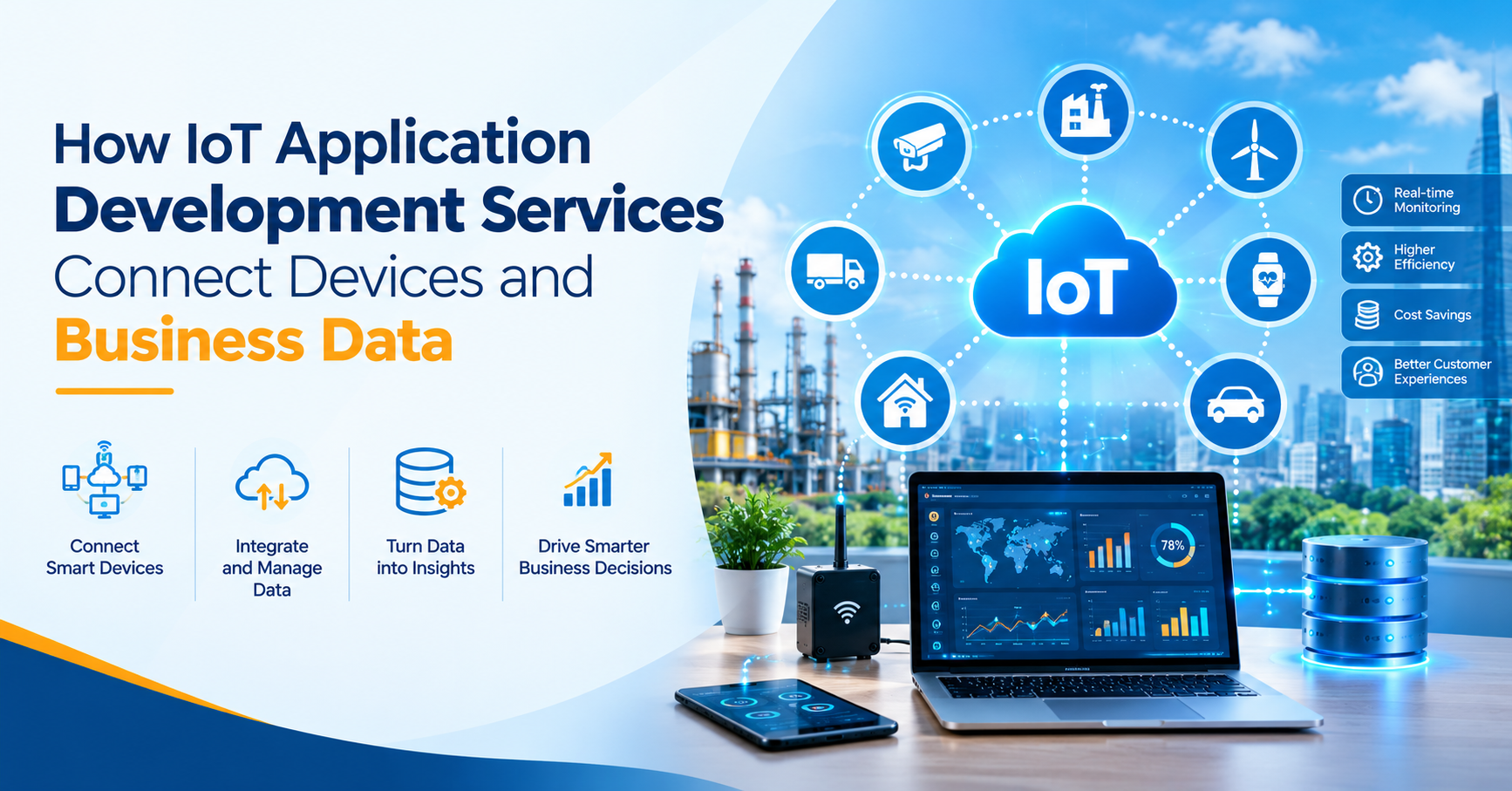
Businesses generate data through machines, sensors, vehicles, equipment, and connected products every day. Yet collecting information does not automatically improve performance. Organizations need systems that can capture device signals, interpret their meaning, combine them with business records, and deliver useful information to the people responsible for operational decisions. This is where Internet of Things (IoT) application development plays a central role.
The scale of connected technology continues to grow. IoT Analytics reported that the number of connected IoT devices reached 18.5 billion in 2024 and forecast 21.1 billion by the end of 2025, representing 14% annual growth. Its October 2025 outlook projected 39 billion connected devices by 2030.
Connectivity forecasts reinforce this trend. Ericsson reported approximately 4.5 billion cellular IoT connections at the end of 2025, with projections reaching 7.8 billion by 2031. Its outlook reflects growing demand for connected applications across industrial operations, logistics, utilities, and other enterprise environments.
These developments create a practical challenge for business leaders: how can organizations convert increasing volumes of device data into reliable operational intelligence? The answer depends on the software architecture connecting physical devices to enterprise applications, analytics platforms, and business workflows.
This article explains how IoT application development services establish that connection, which technical components make it work, how businesses use the resulting information, and how to evaluate the financial impact of an implementation.
1. What Are IoT Application Development Services?
IoT application development services involve designing and building software that connects physical devices with digital systems. These applications collect telemetry, manage device activity, process information, and present results through dashboards, mobile applications, alerts, reports, or automated workflows.
A typical solution combines several components:
Connected devices: Sensors, meters, industrial machines, vehicles, and embedded controllers generate operational data.
Connectivity and gateways: Networks and gateways transmit information between devices, local systems, and cloud platforms.
IoT platforms: Device registries, messaging services, and management tools coordinate communication and device operations.
Data infrastructure: Databases, event-processing systems, and analytics services store and interpret incoming information.
Business applications: Dashboards, ERP systems, CRM platforms, maintenance applications, and reporting tools use the resulting data.
The application connects these components into a usable system. For example, a cold-chain monitoring solution may collect temperature readings from refrigerated vehicles, associate them with shipment records, detect temperature excursions, and notify a logistics manager before products deteriorate.
The business value comes from linking physical conditions to operational context and a defined response.
2. How IoT Applications Move Data from Devices to Business Systems
A reliable IoT architecture manages the complete data journey, from the initial sensor reading to the action a business takes.
Step 1: Devices collect operational data
Sensors measure physical conditions such as temperature, pressure, vibration, humidity, location, energy consumption, or machine speed. Embedded software reads these measurements and packages them into messages.
The device may transmit every few seconds, at fixed intervals, or only when a measurement crosses a threshold. The right reporting frequency depends on the application's requirements, battery capacity, network costs, and the speed at which conditions can change.
Data quality begins at this stage. Poor sensor calibration, incorrect timestamps, or inconsistent units can undermine every downstream report.
Step 2: Connectivity transports the data
Devices use communication technologies suited to their operating environments. Bluetooth Low Energy works well for short-range communication, Wi-Fi supports local network access, and cellular networks serve applications that need broader geographic coverage. LoRaWAN can support low-power, long-range deployments with modest data requirements.
Industrial environments may also use protocols such as Modbus, CAN, or OPC UA to exchange information with machinery and control systems.
Gateways often translate legacy protocols into formats that cloud applications can process. They can also buffer data during network outages, filter unnecessary messages, and perform basic local analysis.
Step 3: An IoT platform receives and manages messages
An IoT platform handles device registration, authentication, message ingestion, and communication routing. Protocols such as MQTT support lightweight publish-and-subscribe messaging, while HTTPS suits many request-and-response interactions.
The platform should identify devices, validate incoming messages, and route information to appropriate processing services. It may also manage device configuration, firmware versions, and remote commands.
Reliable implementations account for duplicated messages, interrupted connections, and devices that reconnect after extended periods offline.
Step 4: Data processing adds context
Raw telemetry rarely provides enough information for business decisions. A temperature reading of 8°C means little without knowing which shipment produced it, what product it contains, how long the reading persisted, and what temperature range the product requires.
Processing services enrich telemetry with asset identifiers, customer details, location records, maintenance history, or production schedules. They may calculate rolling averages, identify abnormal patterns, and compare readings against business rules.
The application can then distinguish a brief sensor fluctuation from a genuine operational issue.
Step 5: Business systems receive usable information
After processing, the application sends relevant information to dashboards, data warehouses, ERP platforms, maintenance systems, or customer applications.
For example, a detected equipment fault might create a maintenance ticket, attach diagnostic readings, identify the affected asset, and notify the responsible technician. This integration turns device data into an operational task rather than another entry in a dashboard.
The quality of the integration determines whether employees can act on the information within their existing workflows.
3. Why Data Integration Matters More Than Data Collection
Many organizations already collect information through machine controllers, spreadsheets, enterprise applications, and separate monitoring platforms. The problem often lies in disconnected records rather than a complete absence of data.
IoT applications address this issue by linking device events with the systems that manage business operations.
Consider a manufacturer that monitors machine temperature but stores production schedules in an ERP system and maintenance history in a separate application. An isolated sensor dashboard can show a temperature increase, but it cannot easily explain whether the machine is running a high-load production cycle or has a history of similar faults.
An integrated application can combine all three data sources. It can compare current readings with normal operating ranges, identify related maintenance events, and notify the maintenance team with relevant context.
Effective integration requires consistent asset identifiers, standardized timestamps, data validation, and clear ownership of business records. APIs, event streams, and data connectors help applications exchange information without forcing every system into a single database.
Teams should also define which system owns each record. For example, an ERP platform may remain the authoritative source for work orders, while the IoT platform manages device telemetry and configuration.
This separation reduces conflicting records and makes the architecture easier to maintain.
4. Essential Features of an Enterprise IoT Application
The required feature set depends on the use case, but enterprise deployments generally need several core capabilities.
Real-time monitoring and alerts
Dashboards display current readings, historical trends, device status, and operational indicators. Alert rules notify teams when measurements exceed acceptable limits or a device stops reporting.
Good alert design reduces unnecessary notifications by considering persistence, severity, asset importance, and escalation rules.
Remote device management
Operations teams need to register devices, update configurations, monitor connectivity, and deploy firmware securely. Fleet-management capabilities become especially important when a business operates thousands of devices across multiple locations.
Analytics and predictive insights
Applications can identify trends, compare operating patterns, and detect anomalies. Predictive maintenance systems may estimate equipment failure risk by combining sensor histories with maintenance records and operating conditions.
These predictions require appropriate training data, validation, and ongoing performance monitoring. A model cannot reliably predict failures that its data does not adequately represent.
Reporting and business integration
Role-specific reports help managers evaluate energy consumption, asset utilization, delivery performance, product quality, and maintenance costs. Integration with ERP, CRM, and business intelligence tools connects operational measurements with financial and customer outcomes.
Offline operation and recovery
Industrial and remote deployments cannot always depend on continuous connectivity. Local buffering, retry policies, message ordering, and recovery procedures help preserve information during outages.
The application should also show when data is stale, so users do not mistake an old measurement for a current operating condition.
5. Security and Reliability Across the Data Flow
Connecting devices to enterprise systems creates additional entry points that attackers may target. Security therefore needs to cover the device, network, cloud services, applications, and administrative interfaces.
Core safeguards include device identity, strong authentication, encryption, role-based access controls, secure firmware updates, and centralized monitoring. Teams should also maintain an inventory of deployed devices and software dependencies so they can identify affected assets when vulnerabilities emerge.
Network segmentation can help prevent a compromised sensor from gaining unnecessary access to business-critical systems. For industrial environments, teams should separate monitoring functions from safety-critical control systems and validate any remote commands before execution.
Reliability also requires operational monitoring. Development teams should track message delivery, processing delays, device availability, application errors, and data quality. Clear recovery procedures help staff diagnose problems without losing critical operational history.
A well-designed application makes failures visible and provides enough diagnostic information for technical teams to resolve them.
6. How Different Industries Use Connected Business Data
IoT applications deliver value when they address specific operational decisions.
Manufacturing: Machine telemetry helps production teams monitor output, identify bottlenecks, detect abnormal operating conditions, and schedule maintenance.
Logistics: GPS, temperature, and door sensors provide shipment visibility, support delivery planning, and help identify cold-chain violations.
Energy and utilities: Smart meters and equipment sensors reveal consumption patterns, support fault detection, and help operators monitor distributed infrastructure.
Healthcare: Connected equipment can report device status and support asset tracking, subject to applicable privacy, safety, and regulatory requirements.
Agriculture: Soil moisture, weather, and irrigation data help growers adjust watering schedules and monitor field conditions.
Commercial buildings: Occupancy, air quality, and energy measurements help facilities teams evaluate comfort, equipment performance, and utility costs.
Each application needs a different combination of connectivity, processing speed, security, and integration. A battery-powered agricultural sensor may prioritize low energy consumption, while a production-line monitoring system may require rapid local responses and integration with industrial controllers.
The architecture should follow the operational requirements, not the popularity of a particular technology.
7. Real-World Example: Piramal Glass Connects Production Data
Piramal Glass provides a documented example of how connected equipment can improve access to manufacturing information.
According to Microsoft's published case study, the company implemented its Real-Time Manufacturing Insights solution across 46 production lines at four plants. The deployment used Azure IoT technology to collect equipment and sensor data and provide real-time visibility into manufacturing operations.
The case study reports cost reductions of up to 70% compared with a glass-industry manufacturing execution system. Microsoft also describes the solution's role in identifying production losses and improving visibility into quality and line efficiency.
The important lesson is architecture. Sensors provided measurements, connectivity moved them into the platform, and application-level analysis made those measurements useful to production teams. The company could examine operational conditions across production lines rather than relying solely on manual records or isolated machine readings.
The reported cost comparison reflects Piramal Glass's specific implementation and reference system. Businesses should not assume they will achieve the same savings without evaluating their own infrastructure, baseline costs, deployment scope, and operational processes.
8. How to Measure ROI and Business Impact
An IoT application should produce measurable business outcomes. Before deployment, define a baseline and choose metrics that connect technical performance with financial results.
Useful indicators include:
Unplanned downtime hours per month.
Maintenance cost per asset.
Defect rates and material waste.
Energy consumption per production unit.
Delivery delays and temperature excursions.
Time required to identify and resolve incidents.
Device availability and successful message delivery.
Consider a facility that spends $150,000 annually on avoidable equipment downtime. If a monitoring application reduces that expense by 20%, the estimated annual benefit equals $30,000.
Suppose implementation costs $50,000 and annual cloud and support expenses total $8,000. The first-year net impact would be negative $28,000, calculated as $30,000 in savings minus $50,000 in implementation costs and $8,000 in operating costs.
In subsequent years, the estimated annual net benefit would reach $22,000, assuming the savings and operating expenses remain constant. The simple payback period would be approximately 2.27 years, calculated as the $50,000 initial investment divided by $22,000 in annual net benefit.
This illustrative calculation excludes financing costs, taxes, discounting, and changes in performance. A full business case should also account for hardware, connectivity, integration, training, and ongoing security maintenance.
Track actual results after deployment and compare them with the original baseline. This helps distinguish realized savings from projections and gives decision-makers evidence for expanding the implementation.
9. Practical Steps for Implementing an IoT Application
A phased implementation gives teams opportunities to validate assumptions before committing to a large deployment.
Define the business problem. Identify the decision the application should improve and the metric that will demonstrate success.
Map data sources. Document sensors, controllers, legacy systems, enterprise databases, and required integration points.
Design the architecture. Select appropriate connectivity, gateways, messaging protocols, storage, processing, and application components.
Build a focused pilot. Test representative devices and operating conditions with measurable acceptance criteria.
Validate security and reliability. Test access controls, network outages, device recovery, data quality, and failure handling.
Integrate business workflows. Ensure alerts, reports, and events reach the employees and systems responsible for acting on them.
Expand in stages. Monitor operational results, improve the implementation, and extend deployment based on evidence.
Organizations should also assign responsibility for device maintenance, data governance, application ownership, and security updates before production launch. Clear accountability prevents gaps between engineering, IT, and operations teams.
Final Thoughts
IoT applications connect physical operations with business data by combining device telemetry, reliable communication, data processing, analytics, and enterprise integration. Their value depends on how effectively they transform measurements into accurate information and actionable workflows.
Businesses should begin with a defined operational problem, design the architecture around real-world constraints, and treat security, data quality, and integration as core requirements. A phased rollout and measurable performance indicators help teams validate both technical reliability and financial value.
The strongest implementations do more than display connected-device readings. They give employees the context needed to respond to equipment problems, improve production, protect product quality, and make informed decisions. When an organization connects device data to clear business objectives, IoT application development becomes a practical foundation for better operational control and long-term digital growth.
About the author
I am a Technical Consultant and Content Creator with over 5 years of experience. I have a deep understanding of the technical aspects of software development, and I am able to translate technical concepts into easy-to-understand language. I am also a skilled problem solver, and I am able to identify and troubleshoot technical issues quickly and efficiently.
Comments
Join the discussionNo comments yet. Be the first to comment.


